Senior Downsizing in Northeast Florida: Step-by-Step Guide
Planning a parent's move? Sort, estate sale, assisted-living coordination, mover selection, and Florida-specific considerations — a practical playbook.
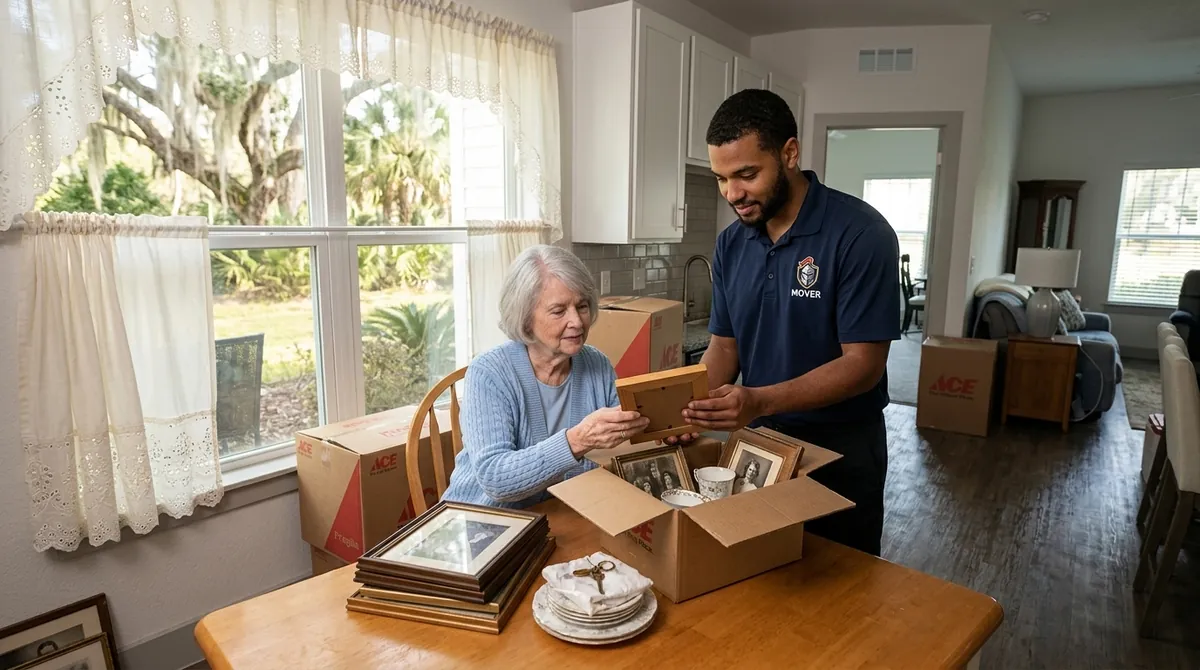
The conversation nobody wants to have
You’re an adult child, often in your 50s or 60s yourself, watching your parent navigate aging in place in a 3,000-square-foot house that no longer fits their needs. Maybe the trigger is a fall, a health diagnosis, a partner’s death, a maintenance issue they can no longer keep up with. Maybe it’s the gentler version: they’ve decided themselves it’s time, and they’re asking you to help.
A senior downsizing move is the single hardest move category to do well. The emotional weight, the family dynamics, the time pressure (often artificial, sometimes real), the volume of decisions about objects with sentimental significance — none of these are present in a normal house move.
This guide is for adult children planning or coordinating a parent’s downsizing move in Northeast Florida. Step-by-step, with attention to the things that consistently go wrong. We’ve sat through dozens of these conversations and seen what works.
The eight-to-twelve week timeline
Senior moves that are compressed into one or two weeks consistently create:
- Distress for the parent (rushed decisions about meaningful items)
- Family conflict (siblings disagreeing about what goes where)
- Decisions later regretted (donated items that should have stayed, kept items that aren’t usable in the new space)
- Crew problems (rushed move-day execution, damage)
Plan for eight to twelve weeks if circumstances allow. The phasing:
- Weeks 1-2: Family meeting and destination decisions
- Weeks 3-5: Sort and decisions per category (kitchen, living room, bedroom, garage, attic, basement)
- Weeks 6-8: Estate sale, consignment, donation pickups
- Weeks 9-10: Mover bookings, packing scope decisions, final inventory
- Weeks 11-12: Move day, settle-in week
Emergency moves (hospital discharge requiring immediate placement, sudden health crisis) sometimes compress this. When possible, plan ahead.
Phase 1: family meeting and destination
Before any sorting starts, the family needs alignment on:
- Where the parent is going. A smaller apartment, an adult child’s home with an in-law suite, an independent living community, an assisted living facility, a continuing care retirement community (CCRC), or a memory care facility. Each has different space allocations and lifestyle implications.
- How long this move is expected to last. Independent living that may transition to assisted living in 2-3 years means downsizing in stages, not all at once. A direct move to memory care is usually a permanent placement.
- Who is coordinating. One adult child takes the lead. Others contribute. Trying to coordinate by committee across multiple time zones is the most common source of family conflict.
- Budget. Movers, packing, storage, estate sale fees, possibly senior move manager — all real costs.
Get this in writing — even a simple shared document. Decisions made in conversation and not documented get re-litigated later.
Phase 2: sort by category, not by room
The intuitive approach (start in the kitchen, then the living room, etc.) is the wrong approach. Sorting by category is the right approach:
- Books. All books from all rooms in one place. Decide as a category.
- Clothing. Closet, dresser, attic storage, garage storage — all together.
- Kitchen items. Cookware, dishes, small appliances, pantry.
- Furniture. Each piece — keep, family, sell, donate.
- Art and decorations. Walls, shelves, drawers.
- Documents and photographs. The largest emotional category.
- Tools, garage, attic. Lowest-emotion category, often easiest.
Within each category, every item gets one of four labels: keep (goes to new home), family (specific person), sell (estate sale or consignment), donate (charity), discard (junk).
For elderly parents, especially those with cognitive impairment, do this in 90-minute sessions, not multi-hour marathons. The decision fatigue is real.
Phase 3: the new floor plan
Get a floor plan of the new residence. Measure the new rooms. Decide which furniture fits and which doesn’t before sorting decisions — otherwise you keep furniture that won’t fit and have to make the decision twice.
For most senior downsizing destinations:
- Independent living apartment: 700-1,200 sq ft. Holds 1 bedroom of furniture + small living room + kitchen + bathroom essentials.
- Assisted living suite: 350-550 sq ft. Holds bed, dresser, small loveseat or recliner, side table, lamp, TV. Not much else.
- Memory care suite: Often 250-400 sq ft. Bed, dresser, one chair. Personal items only.
- Adult child’s in-law suite: Varies wildly — measure specifically.
The conversation about what fits is easier when the parent can see the new floor plan with their furniture marked to scale.
Phase 4: estate sale, consignment, donation
For items that don’t make the move:
- Estate sale companies handle whole-house clearouts. They take a percentage of proceeds (typically 30-40 percent). Useful for high-volume situations. Schedule 4-6 weeks ahead.
- Consignment shops (antiques, art, furniture) take specific high-value pieces and may net more than estate sale for those pieces. Furniture consignment in Northeast Florida includes shops in Jacksonville Beach, San Marco, and St. Augustine.
- Donation: Habitat for Humanity ReStore picks up furniture in usable condition. Salvation Army and Goodwill also accept furniture. Books to local libraries. Clothing to local shelters.
- Junk removal: For broken or unusable items, junk removal service handles disposal. Many licensed Florida movers offer junk removal as an add-on service.
Family members who want specific items should claim them in writing. “Mom said I could have the dining table” is the seed of decades of family disputes — get it in writing now.
Phase 5: mover selection
For senior downsizing moves in Northeast Florida:
- Hire an FDACS-registered intrastate Florida mover. Verify at fdacs.gov/Business-Services/Movers. Senior moves are a high-target category for predatory unlicensed operators.
- Get the COI in writing. Required by most independent living, assisted living, and memory care facilities — they will not let an uninsured mover into the building.
- Confirm the inventory walk is real. In-home or video. A “guesstimate” by phone is the wrong starting point.
- Confirm the type of estimate (binding, non-binding, not-to-exceed).
- Ask about senior-specific protocols. Padded protection in tight corridors, slow-pace loading, emotional sensitivity to certain items. Not every mover defaults to these.
- Confirm the destination facility’s move-in policies. Some assisted living facilities restrict move-ins to weekday business hours and require COI 72 hours in advance.
For complex situations — cognitive decline, family conflict, out-of-state adult children — consider hiring a certified senior move manager (CSMM through NASMM, the National Association of Senior Move Managers). They coordinate sorting, family communication, estate sale, mover hiring, and settle-in.
Phase 6: move day and settle-in
The parent should be present at the destination when furniture arrives — at minimum the first hour. Why:
- Confirm room placement (bed against this wall, not that wall)
- Mirror the prior layout where possible (couch facing the same direction relative to the TV)
- Photos and artwork hung at familiar heights
- Feels like ownership of the new space rather than waking up in unfamiliar terrain
The parent’s presence at origin is more flexible. Many seniors find watching the actual loading emotionally difficult and prefer to be at a relative’s home during the load. Judgment call.
Settle-in week: routine helps. Set up the bedroom first (familiar bed, sheets, alarm clock, lamp). Then the bathroom (familiar toiletries, towels). Then the living room. Kitchen last for most layouts. Walk the parent through the new building (mailroom, dining room, activities calendar, emergency exit).
Expect emotional dysregulation in week one. It’s normal. By week three, most senior placements have stabilized into the new routine.
Florida-specific considerations
- Homestead exemption. If the parent is selling a long-held Florida homestead and moving to assisted living within Florida, the homestead benefit may transfer with Save Our Homes portability — coordinate with a Florida-licensed real estate attorney or tax advisor.
- Hurricane season scheduling. Build a reschedule buffer into any June-November move date.
- Heat sensitivity. Summer Florida moves require early-morning crew arrival and air-conditioned transport for the parent — heat exhaustion risk is elevated for seniors.
- Climate-controlled storage. If the move involves a storage segment, climate control matters. See storage options.
- FDACS verification. Florida Statute Chapter 507 protects consumers — verify the mover at fdacs.gov before signing.
What H2H Moving brings to senior downsizing
Standard practice on senior moves:
- Free in-home or video inventory walks (longer, less hurried than a standard estimate)
- Senior-paced loading and unloading
- Padded corridor and doorframe protection
- COI submitted to assisted living, memory care, or independent living facility in advance
- Climate-controlled vehicle for the parent’s personal transport (we can refer or coordinate)
- Settle-in support (furniture placement, basic unpacking) as an add-on scope
For senior downsizing planning or estimate, call (904) 209-9277 or request online. We serve all of Northeast Florida and routinely work with assisted living and independent living facilities across St. Johns County and Duval County.
Related reading: Cost to move in Northeast Florida 2026 · Best time of year to move to Florida · Storage options in St. Johns and Jacksonville · Our senior moving service · Our packing services
Frequently Asked Questions
How long should I plan for a senior downsizing move? add
Eight to twelve weeks for a thoughtful, low-stress process. Senior moves that are compressed into one or two weeks consistently create distress for the parent, family conflict, and decisions later regretted (items donated that were emotionally significant, items kept that should have been sold). The recommended phasing is: weeks 1-2 family meeting and destination decisions, weeks 3-5 sorting and decisions about each item category, weeks 6-8 estate sale or consignment, weeks 9-10 mover bookings and packing, weeks 11-12 move day and settle-in. Emergency moves (parent's health change, hospital discharge requiring immediate placement) are sometimes unavoidable but should be the exception.
Should I hire a senior move manager or a regular moving company? add
Both, often. A certified senior move manager (CSMM through NASMM) specializes in the emotional and logistical complexity of downsizing — sorting decisions, family coordination, estate sale referral, settling the parent into the new space, hanging artwork at familiar heights. A licensed moving company handles the physical move itself. The two services are complementary, not redundant. For straightforward downsizing where family is local and engaged, a moving company alone may be sufficient. For complex situations (cognitive decline, family conflict, out-of-state adult children, multiple homes), a senior move manager is often the right primary coordinator with the moving company contracted as part of the plan.
What do I do with the furniture that doesn't fit the new place? add
Five common paths. First, family — adult children, grandchildren, siblings often want specific pieces with sentimental value. Take photos and circulate before deciding what stays in the move. Second, estate sale — local Northeast Florida estate sale companies handle entire houses, typically taking a percentage of proceeds, useful for whole-house clearouts. Third, consignment — specific high-value pieces (antiques, art) often net more through specialty consignment than estate sale. Fourth, donation — Habitat for Humanity ReStore, Salvation Army, and Goodwill all accept furniture in usable condition. Fifth, removal — for items with no value, removal service or junk removal handles disposal. Most senior downsizing combines several of these.
Does the parent need to be present for the move? add
Almost always, yes — at the new destination at minimum. Being present at the new place when furniture is placed allows the parent to confirm room arrangement, make adjustments to mirror layouts of the prior home where possible, and feel ownership of the new space rather than waking up the next morning in unfamiliar terrain. At the origin, presence is more flexible — many seniors find watching the actual loading emotionally difficult and prefer to be at a relative's home during the load. The judgment call depends on the parent. The destination presence is the higher priority.
What's the Florida Statute Chapter 507 implication for senior moves? add
Florida Statute Chapter 507 requires licensed household goods movers to provide written estimates, follow specified consumer-protection rules, and submit to FDACS dispute resolution. For senior moves specifically, this matters because the population is more vulnerable to moving scams — predatory hostage-shipment operators, undisclosed mid-move fee increases, and uninsured damage claims. Always hire an FDACS-registered intrastate Florida mover for any senior downsizing move. Verify at fdacs.gov/Business-Services/Movers. For adult children coordinating from out of state, request the COI and FDACS registration in writing before signing anything.
Planning a move? Talk to a real person.
Happy 2 Help Moving is locally owned and owner-operated by Devin Vangel in St. Augustine, FL. Free quotes, no pressure.
Get a Free Quote arrow_forwardor call (904) 209-9277