Storage Options St. Johns + Jax: Climate vs Standard
Climate-controlled vs standard storage in Northeast Florida — what each protects, when each is right, and how to coordinate storage-in-transit with a move.
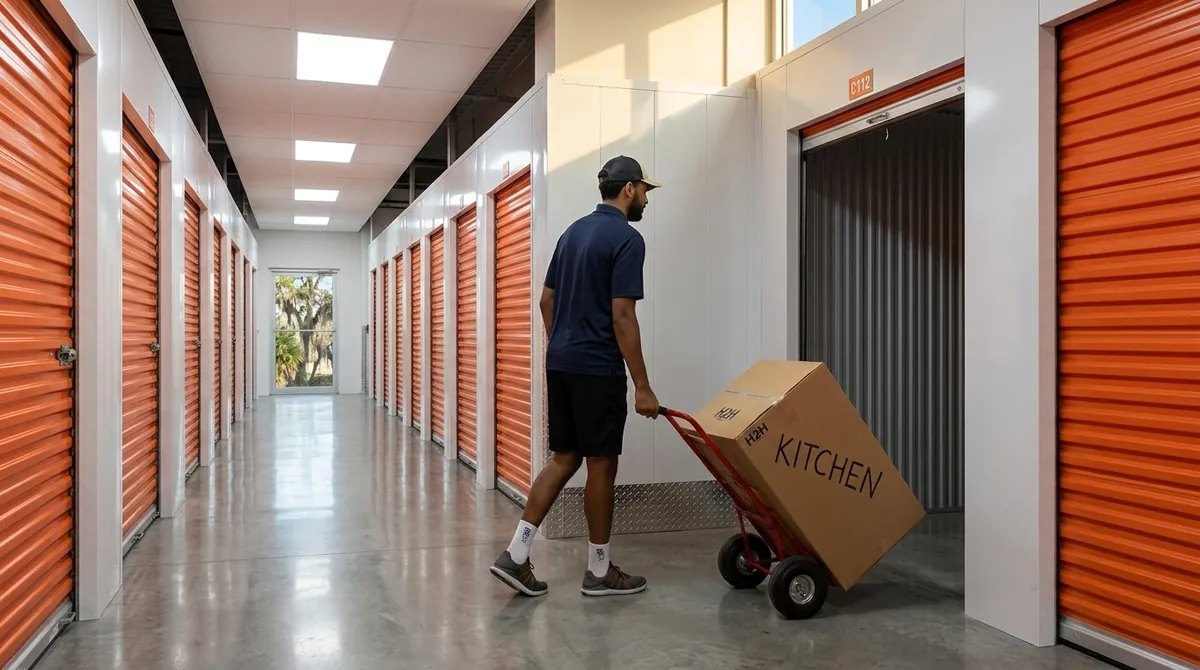
Storage: more common in Northeast Florida than most movers realize
Roughly 25-30 percent of Northeast Florida moves involve some storage segment. Common scenarios:
- Sell the old house, gap before the new house closes
- Relocating to Florida ahead of housing finalization
- Downsizing — keep some items pending decision
- Military PCS to a temporary location
- Renovation gap — between moving out and moving back in
- Snowbird — store furniture and personal items during the off-season
- Estate / inheritance — store inherited goods until decisions are made
The two main storage modalities have different cost structures, access patterns, and use cases. This guide walks through both for the Northeast Florida market specifically — climate considerations, what each protects, and how to coordinate storage with a move.
If your move involves any storage segment, read this before signing the storage lease.
Climate matters more in Northeast Florida than in most U.S. markets
Northeast Florida summer climate puts storage decisions in a different category than the same decision in, say, Denver or Boston. Standard self-storage units in St. Johns and Jacksonville:
- Regularly hit 90-100F interior temperature in July and August
- Track outdoor humidity (80 percent+ in summer)
- Experience daily temperature swings of 15-25F
- Can exceed 120F on south-facing exterior units during peak summer afternoons
These are not climate-controlled environments. They are weather-exposed metal sheds with concrete floors.
Climate-controlled units, by contrast:
- Maintain temperature between 55-85F year-round
- Maintain humidity in the 40-60 percent range
- Are interior units (no direct outside wall exposure)
- Often have additional fire suppression and pest control
The premium for climate-controlled is real but modest — for any storage period over two weeks during the June-September window, the math favors climate-controlled for most household contents.
What you can store in standard self-storage
Items that tolerate Northeast Florida summer non-climate conditions:
- Plastic outdoor furniture
- Metal tools, equipment, lawn and garden gear
- Bicycles, kayaks, surfboards (limited UV exposure)
- Ceramic dishware, glass items (sealed in boxes)
- Sealed plastic-tote contents
- Most automotive parts
- Outdoor sporting equipment
These items can survive months in a standard unit without measurable degradation.
What needs climate-controlled storage
Items at real risk in Northeast Florida summer non-climate storage:
- Wood furniture. Joint failure from humidity swings, finish warping, veneer lifting. Solid-wood antiques are the most vulnerable.
- Leather. Mildew growth in high humidity. Surface cracking on dried-out leather. Couches, jackets, accessories.
- Photographs and paper. Warping, yellowing, emulsion damage in old photos.
- Electronics. Capacitor stress above 130F. Lithium-battery degradation. TVs, computers, AV gear, vintage equipment.
- Wool and natural-fiber clothing. Mildew growth. Moth risk in poorly-sealed units.
- Wine and spirits. Wine spoils above 80F sustained.
- Art and antiques. Frame joint failure, canvas warping, oil paint degradation.
- Musical instruments. Wood instruments (guitars, violins, pianos) are extremely sensitive — neck warping, finish damage, tuning instability.
- Documents. Important papers, vital records. Climate-controlled is the right default.
- Books. Page yellowing, binding glue failure, mildew.
For any of the above going into storage for more than two weeks in summer, climate-controlled is the right call.
Storage-in-transit vs self-storage
Two different services for two different use cases:
Self-storage
You rent a unit directly from a storage facility. Major Northeast Florida operators:
- Public Storage — multiple locations across Duval and St. Johns
- CubeSmart — dense Jacksonville coverage
- Extra Space Storage — multiple St. Augustine and Jacksonville locations
- U-Haul Storage — large Northeast Florida network, often combined with truck rental
- Life Storage — newer to the market, growing footprint
- Independent operators — local options, often competitive on price
You sign the lease directly. You move goods in and out (or hire labor). You hold month-to-month or longer. You’re responsible for insurance on contents (most home insurance policies extend partial coverage to off-premises storage — verify with your insurer).
Right choice for: long-term storage independent of a move, recurring storage (boat, RV, seasonal items), business storage, low-volume personal storage where you need frequent access.
Storage-in-transit (SIT)
The moving company loads your goods at origin, holds them in their warehouse, and delivers to destination when you’re ready. Typically billed daily or monthly during the storage period.
Right choice for:
- Closing-date misalignment (sold the old house before the new house is ready)
- Out-of-state moves where housing isn’t finalized
- Renovation gap (between out and back into the same home)
- Military PCS to a temporary location
- Downsizing where some items need a decision period
The SIT advantage: one mover handles origin pickup, storage, and final delivery — single accountability chain, single inventory, no separate storage move-in / move-out labor cost.
The SIT trade-off: less access to your stored goods during the storage period. Some movers offer scheduled access (typically by appointment, sometimes with a fee per access). It’s not the same as walking into your storage unit anytime.
How much storage do you need?
Working approximations for Northeast Florida self-storage:
| Home Size | Typical Unit | Dimensions |
|---|---|---|
| Studio apartment | 5x10 | 50 sq ft |
| 1-bedroom apartment | 10x10 | 100 sq ft |
| 2-bedroom home | 10x15 | 150 sq ft |
| 3-bedroom home | 10x20 | 200 sq ft |
| 4-bedroom home | 10x25 or 10x30 | 250-300 sq ft |
| 5+ bedroom or with garage | 10x30 plus | 300+ sq ft |
Variables that change actual fit: furniture geometry, how efficiently the unit is loaded, vertical space utilization (most units have 8-10 foot ceilings; using full height changes sizing dramatically), and whether contents are well-organized in boxes vs loose.
For a typical 3-bedroom Northeast Florida household, a 10x20 climate-controlled unit holds most contents with room to access boxes selectively.
Questions to ask any Northeast Florida storage operator
Before signing any storage lease:
- Is the unit climate-controlled? What’s the temperature and humidity range?
- Access hours? 24/7 vs gated business hours.
- Surveillance and monitoring? Active camera system, on-site staff hours.
- Insurance on stored contents? Facility liability vs your responsibility. Most facilities require you to carry your own insurance.
- Pest control protocol? Frequency, methods, evidence of issues.
- Truck access? Can a 26-foot moving truck pull up directly to the unit, or is there a parking-lot distance?
- Unit sizes available? Confirm dimensions, not just rated size — there are variations.
- Lease commitment structure? Month-to-month vs minimum term. Cancellation policy.
For SIT specifically:
- Warehouse climate? Same climate-control question.
- Loading and unloading labor cost? Often separate from monthly storage fee.
- Access during storage? Frequency, cost per access.
- Insurance during storage period? Should be covered by mover liability — confirm in writing.
What H2H Moving provides
H2H Moving offers storage-in-transit coordination as part of a residential or commercial move. We:
- Load at origin, climate-controlled warehouse storage, deliver to destination on your timeline
- Inventory tracking — you know what’s in storage
- Monthly billing during the storage period
- Climate-controlled warehouse (not exposed metal sheds)
- Insurance coverage during the storage period as part of the mover policy
- Single-accountability chain — same crew, same inventory, same paperwork from origin through destination
For longer-term self-storage needs independent of a move, we maintain relationships with established Northeast Florida operators across St. Johns County and Duval County, and can refer based on your location and requirements.
For a storage-inclusive move estimate, call (904) 209-9277 or request online. We serve Northeast Florida — St. Augustine, Ponte Vedra Beach, Nocatee, Jacksonville, and the broader region.
Related reading: Cost to move in Northeast Florida 2026 · Packing for a Florida summer move · Senior downsizing step-by-step · Best time of year to move · Our packing services
Frequently Asked Questions
Do I need climate-controlled storage in Northeast Florida? add
For most household goods being stored more than two weeks during summer, yes. Standard self-storage units in St. Johns and Jacksonville regularly hit 90 to 100F interior temperature in July and August, with humidity tracking outdoor levels around 80 percent. Items at real risk in non-climate storage during Northeast Florida summers: wood furniture, leather, photographs and paper, electronics, wool and natural-fiber clothing, wine and spirits, art and antiques. Items that tolerate non-climate storage year-round: plastic outdoor furniture, metal tools, ceramic, glass, sealed plastic-tote contents. For winter-only short-term storage (December through February), the climate gap narrows and standard storage works for more categories.
What's the difference between self-storage and storage-in-transit? add
Self-storage is a unit you rent directly from a storage facility (Public Storage, CubeSmart, Extra Space, U-Haul Storage, or independent operators). You load and unload it yourself or hire labor. You hold the lease month-to-month. Storage-in-transit (SIT) is a service provided by a moving company — they load your goods at origin, store them in their warehouse, then deliver to the destination when you're ready. SIT is the right choice for inter-move gaps (closing dates don't align, relocating before housing is finalized, military PCS to a temporary location). Self-storage is the right choice for long-term storage independent of a move.
What questions should I ask a Northeast Florida storage facility? add
Eight questions. Is the unit climate-controlled and what's the temperature and humidity range? Is the facility 24/7 access or gated-hours? Is there video surveillance and active monitoring? What's the insurance coverage on stored contents and what does the facility liability cover? Is there pest control protocol? What's the access road condition for moving truck delivery? What sizes are available and what are dimensions (a 10x10 vs 10x15 makes a real difference)? What's the month-to-month vs lease commitment structure? For storage-in-transit specifically, also ask about the loading and unloading labor cost and the climate conditions of the moving company's warehouse.
How much storage do I need for a typical Northeast Florida household? add
Rough sizing. A studio apartment: 5x10 unit. A 1-bedroom apartment: 10x10 unit. A 2-bedroom home: 10x15 unit. A 3-bedroom home: 10x20 unit. A 4-bedroom home with garage contents: 10x30 unit or two 10x15 units. These are working approximations — actual fit depends on furniture geometry, how efficiently the unit is loaded, and how much vertical space you can use. Most overestimation comes from not accounting for stacking and storage tubing optimization. Talk to your mover during the inventory walk if storage sizing is part of the plan.
Does H2H Moving offer storage in Northeast Florida? add
H2H Moving offers storage-in-transit (SIT) coordination as part of a residential or commercial move when there's a gap between origin and destination. We coordinate with established Northeast Florida self-storage operators for longer-term needs. Our SIT service includes loading at origin, climate-controlled warehouse storage, inventory tracking, and delivery to destination on your timeline. For pure self-storage needs (independent of a move), we maintain relationships with operators across St. Johns and Duval counties and can refer based on your location and storage requirements. Always verify any storage operator's insurance and access policies before signing a long-term lease.
Planning a move? Talk to a real person.
Happy 2 Help Moving is locally owned and owner-operated by Devin Vangel in St. Augustine, FL. Free quotes, no pressure.
Get a Free Quote arrow_forwardor call (904) 209-9277