Best Time to Move to Florida: Snowbird Windows + Climate
When to schedule a Northeast Florida arrival — half-year residency rules, hurricane avoidance, snowbird timing, and the off-peak operational sweet spot.
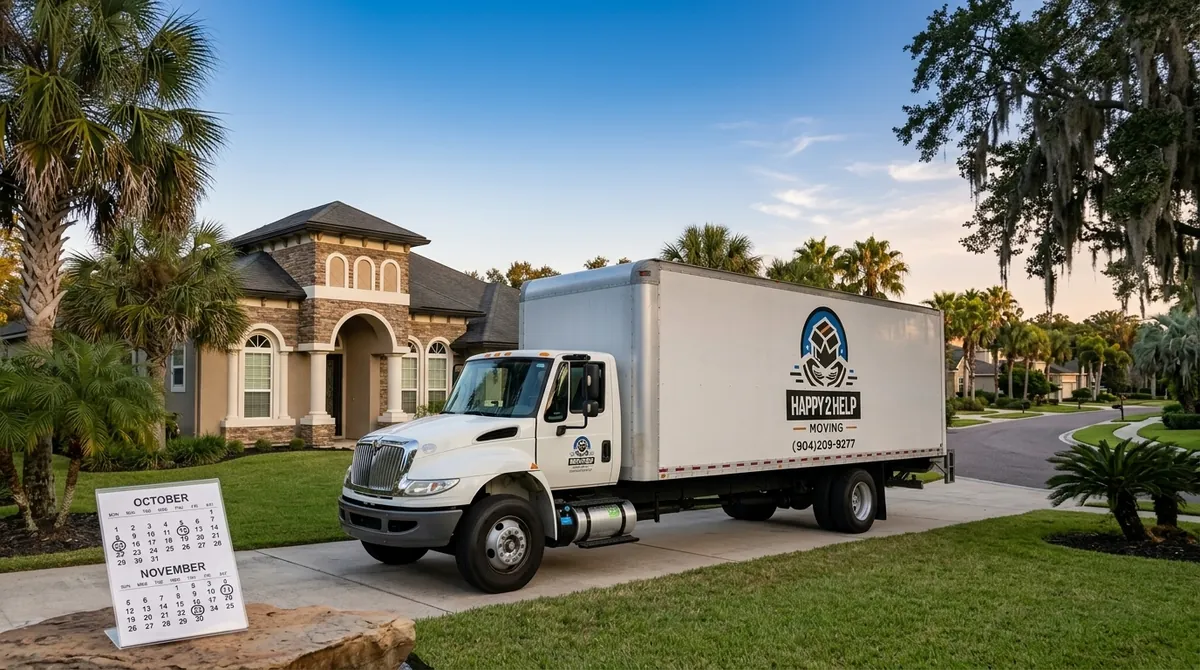
When you move matters more than most people realize
For most household moves to Northeast Florida, the question of when is treated as a constraint set by lease expirations, job start dates, and family schedules. That’s reasonable. But within whatever flexibility you have, the calendar choice affects cost, crew availability, weather risk, and Florida residency planning — sometimes meaningfully.
This guide covers the practical calendar math for any move to or within Northeast Florida in 2026 and beyond. Snowbird windows, half-year residency rules, hurricane avoidance, school-year vs summer trade-offs, and the operational sweet spot most movers don’t talk about.
If you have any flexibility on timing, this matters. If you don’t, the guide will at least set realistic expectations for the window you’re locked into.
The annual rhythm — three peaks and a sweet spot
Northeast Florida moving demand follows a predictable annual pattern:
| Window | Demand Level | Weather Notes | Lead Time |
|---|---|---|---|
| January - March | Low | Cool dry season, occasional rain | 1-2 weeks |
| April | Moderate | Spring warming begins | 2-3 weeks |
| May - June | High | Heat rising, hurricane season starts June 1 | 3-5 weeks |
| July - August | Peak | Heat peak, hurricane risk rising | 4-6 weeks |
| September | Peak | Highest hurricane risk window | 4-6 weeks |
| October - November | Low | Operational sweet spot | 1-2 weeks |
| December | Low-moderate | Cool, holiday timing | 1-2 weeks |
The sweet spot: mid-October through mid-November. Three things converge favorably — hurricane risk drops, demand drops, weather cools. For any move with calendar flexibility, this is the right window.
The pinch point: mid-August through late September. Peak hurricane risk + peak demand + peak heat. Movable but requires built-in buffer.
Snowbird arrival timing — the practical math
Northeast Florida is a major snowbird destination. The annual rhythm:
- Arrival window: Mid-October through mid-December
- Departure window: Mid-April through mid-May
- Typical residency length: 180-210 days
For snowbirds from the Northeast and Midwest, the arrival is timed to:
- Get out of the origin before harsh winter
- Arrive in Florida after hurricane season tails off
- Establish 183-day residency for Florida tax-residency claim (where applicable)
- Settle in before holiday season
The single most important date: November 1. By that date you want to be settled in Northeast Florida, with:
- Florida driver’s license issued (DMV appointments fill weeks ahead — book early)
- Voter registration filed
- Primary residence address declared on insurance, banking, brokerage accounts
- Florida-based primary physician identified (Medicare logistics for snowbird population)
- Homestead exemption application filed (if eligible — must own and occupy by January 1 of the application year)
Florida residency for tax purposes — the 183-day rule
Florida considers you a resident for state tax purposes if:
- You spend more than 183 days per calendar year in Florida, AND
- You demonstrate intent (driver’s license, voter registration, declared homestead, primary insurance address, etc.)
Snowbirds arriving October 1 and departing May 31 = roughly 240 Florida days — well past the threshold. Arriving November 15 and departing April 30 = roughly 167 days — below the threshold.
For the no-state-income-tax benefit to apply to your full income, both the 183-day threshold and the intent test must be cleared. High-income snowbirds (and especially those transitioning from high-tax origin states like New York, New Jersey, or California) face real audit scrutiny on residency claims. Origin states aggressively contest residency changes that they perceive as artificial.
Practical advice: coordinate with a tax advisor familiar with multi-state residency for your specific situation. Document the move thoroughly. The mid-October to mid-November arrival window naturally clears the threshold for snowbird residents.
School-year vs summer — the families question
For families with school-age children, the calendar is functionally constrained:
- Summer move (June-July): Coordinates with school year boundaries. Children start the new school year at the destination. Most disruption-free for academic continuity. Pays peak demand pricing.
- Winter break move (late December): Short window, possible for compressed moves. Cold-weather complications at origin if from northern states.
- Spring break move (March-April): Short window. Better demand pricing than summer. Children miss minimal school days.
- Mid-year move: Required only for emergencies (job change, family crisis). High academic disruption.
For most families, summer (June-July specifically — finishing before the August hurricane peak) is the practical window despite the demand premium. Build the budget for it.
Hurricane window avoidance — the operational reality
Atlantic hurricane season runs June 1 through November 30. Risk is not evenly distributed:
- June - July: Low to moderate risk
- August 1-15: Moderate to high risk
- August 15 - September 30: Peak risk
- October 1-15: Moderate, declining
- October 15 - November 30: Low risk
The NOAA National Hurricane Center (nhc.noaa.gov) issues forecasts 5-7 days out for any named system. For a move scheduled in the peak window, a written reschedule policy from your mover is mandatory — typical commitment is 72-96 hour reschedule notice without charge if a NOAA tropical storm or hurricane watch is issued for the move corridor.
October 15 onward is the steep drop-off. By November 1, the practical hurricane risk is near zero in most years.
End-of-month vs mid-month — the weekly cycle
Within whatever month you choose, the day matters:
- End-of-month (28th-2nd): Highest demand. Most leases turn over. Booking lead times stretch. Crews are exhausted from a week of back-to-back jobs. Day-of issues (delayed start, crew tired) more common.
- Mid-month (10th-20th): Off-peak. Same crews and trucks at the same hourly cost, but more flexibility on scheduling.
- Mid-week (Tuesday-Wednesday): Off-peak day-of-week. Lower demand than weekend.
If you can negotiate a 5-10 day lease overlap (paying a small premium on the old place to enable a mid-month move-out), the operational benefits often outweigh the cost.
End-of-school-year (last week of May, first week of June) is the secondary annual spike beyond end-of-month.
What “best” actually means for your move
For most movers asking this question, best = lowest cost + best service quality + lowest risk. The window that maximizes all three for Northeast Florida arrivals:
- First choice: Mid-October to mid-November, mid-month, mid-week
- Second choice: Mid-November to mid-December, mid-month, mid-week
- Third choice: January to March, mid-month, mid-week
- Acceptable: April through early June (pre-peak)
- Premium-paying but workable: Late June through July (with hurricane reschedule policy)
- Hardest: Mid-August through late September
For families synchronized to school calendars, the constraint usually overrides operational sweet spot — and that’s fine. Plan around the constraint, build the budget for peak pricing, and confirm hurricane reschedule policy if the date sits in the peak window.
What H2H Moving offers for flexible-timing customers
For customers with calendar flexibility:
- Off-peak booking discounts are inherent in shorter lead times and crew availability — pricing reflects demand
- Written hurricane reschedule policy on every estimate June through November
- Multi-month booking for snowbird customers who want to lock the slot 3-6 months ahead
- Calendar consultation during the inventory walk — we’ll discuss your timing options if there’s flexibility
For an estimate on your Northeast Florida move, call (904) 209-9277 or request online. We serve all of Northeast Florida — St. Augustine, Ponte Vedra Beach, Nocatee, Jacksonville, and the broader Jacksonville metro.
Related reading: Hurricane season moving guide · Cost to move in Northeast Florida 2026 · Boston to Northeast Florida snowbird guide · New York to Jacksonville guide · Storage options
Frequently Asked Questions
What's the best month to move to Northeast Florida? add
October and November are the operational sweet spot. Hurricane risk drops sharply by mid-October. Daily temperatures cool into the 70s. Mover demand drops from the May-August peak. Lead times shorten from four-to-six weeks down to one-to-two weeks. Crew availability widens. For snowbirds arriving for the winter half-year, mid-October to mid-November is the ideal window. For permanent relocations with school-age children, summer (June-July) coordinates with school year breaks but pays the demand premium. Avoid August-September if you have any flexibility — peak hurricane season.
How does Florida residency timing work for snowbirds? add
Florida considers you a resident for state tax purposes if you spend more than 183 days per calendar year in Florida and demonstrate intent (driver's license, voter registration, declared homestead, primary insurance address). Snowbirds typically arrive October or November and depart April or May, accumulating roughly 180-210 days. For the no-state-income-tax benefit to apply to your full income, the 183-day threshold must be cleared and the intent test satisfied. Coordinate with a tax advisor for your specific situation — high-income snowbirds in particular face audit scrutiny on residency claims.
Should I move during summer or wait until fall? add
Depends on your priorities. Summer moves (June-July): coordinate with school year breaks for families with children, complete the move before the August-September hurricane peak, but pay peak demand pricing and accept higher heat exposure for the move itself. Fall moves (October-November): lower demand pricing, cooler weather, hurricane risk dropped, but require leaving the previous home during a different family rhythm. For most adult-only households without school-age children, October is the better operational choice. For families synchronized to school calendars, June or July is the practical window.
Is hurricane season really worth avoiding for a Florida move? add
For peak hurricane window (mid-August through late September), yes — build at minimum a 72-96 hour reschedule buffer into your contract. For broader hurricane season (June-November), risk is real but manageable with a written reschedule policy from your mover. The compounding consideration is that the May-August window coincides with both peak mover demand and elevated weather risk. October-November combines lower weather risk with lower demand. The data from the NOAA National Hurricane Center shows hurricane formation drops sharply after October 15. Most years see no Northeast Florida hurricane impact in November.
What about end-of-month vs mid-month moving? add
End-of-month (28th through 2nd) is the highest-demand window across the entire calendar because most leases turn over then. Crew availability is tightest, lead times are longest, and scheduling flexibility is zero. Mid-month (10th-20th) is off-peak — same crews, same trucks, same service quality, but more booking flexibility. If you can negotiate lease overlap with your landlord (paying 5-10 extra days of rent on the old place to enable a mid-month move), the operational benefits often outweigh the cost. End-of-school-year (last week of May, first week of June) is the secondary annual spike — coordinate accordingly.
Planning a move? Talk to a real person.
Happy 2 Help Moving is locally owned and owner-operated by Devin Vangel in St. Augustine, FL. Free quotes, no pressure.
Get a Free Quote arrow_forwardor call (904) 209-9277