Hurricane Season Moving in Northeast Florida (Jun-Nov)
When to book, when to avoid, NOAA tracking windows, and how H2H prepares crews for storm contingencies during Northeast Florida hurricane season.
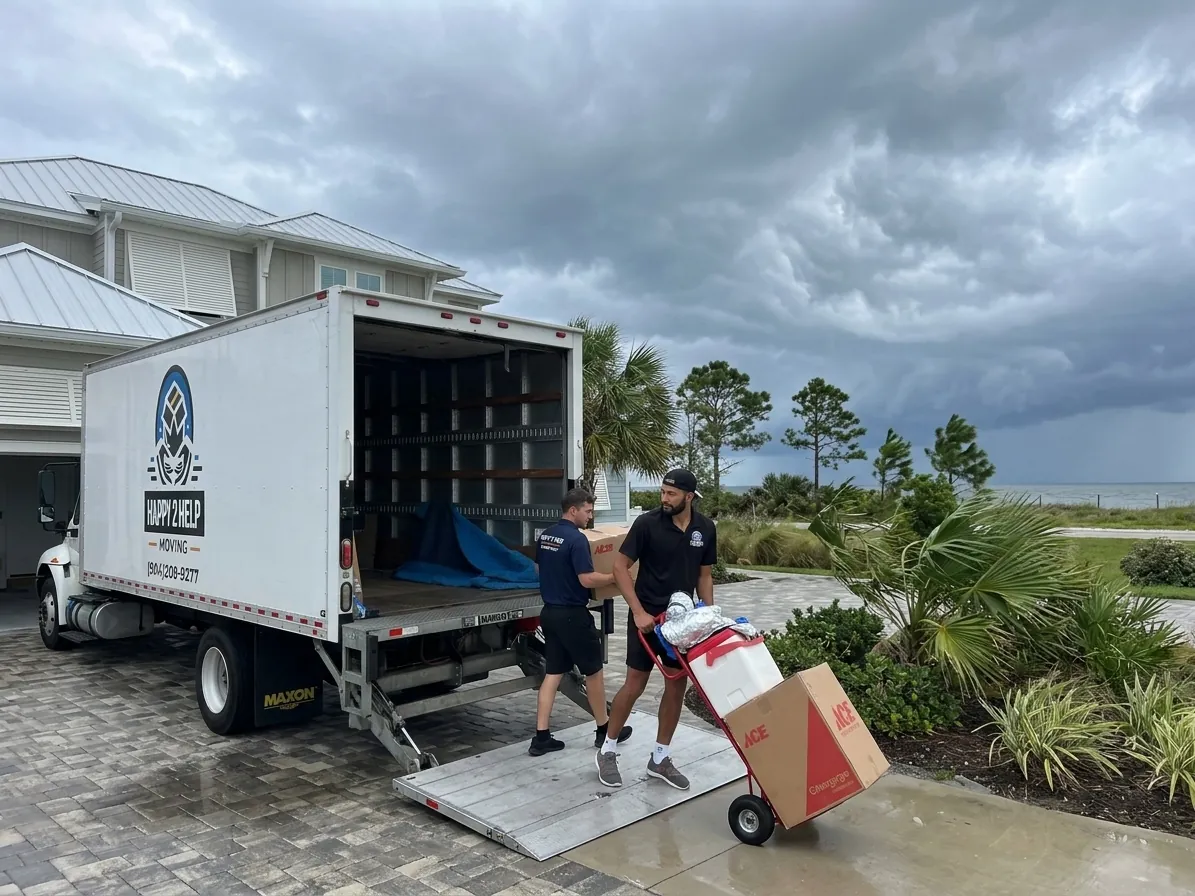
The short answer
Atlantic hurricane season runs June 1 to November 30 — six months that overlap heavily with the May-August Northeast Florida moving peak. This guide covers what hurricane season actually means for your move: when to book, when to avoid, how to read NOAA forecasts, what your mover should do when a storm is approaching, and how to protect your goods during the high-humidity, high-storm-risk window.
If you’re moving anywhere in Northeast Florida between June and November, here’s what you need to know.
When hurricane season actually is
Atlantic hurricane season: June 1 through November 30.
But the risk is not evenly distributed:
| Window | Risk Level | Mover Availability |
|---|---|---|
| June 1 - July 31 | Low-moderate | Moderate (peak demand starts) |
| August 1 - August 15 | Moderate | Tight (peak moving season) |
| August 15 - September 30 | Peak | Tight |
| October 1 - October 31 | Moderate | Moderate (snowbird inbound starts) |
| November 1 - November 30 | Low | Moderate-high (snowbird inbound peak) |
Peak storm activity is mid-August through late September — when ocean temperatures, atmospheric conditions, and the African easterly wave pattern align. The historical climatological peak is around September 10.
Northeast Florida (Jacksonville, St. Augustine, Ponte Vedra, Nocatee) is statistically less hurricane-impacted than South Florida or the Florida Gulf Coast. But it is not immune. Memorable recent storms affecting the region: Matthew (October 2016), Irma (September 2017), Ian (September 2022), Idalia (August 2023).
When to book and when to avoid
Best months for Northeast Florida moves (overall):
- March, April, late October, November, early December — moderate weather, lower humidity, hurricane risk diminished or absent
Acceptable months with buffer:
- June, early July, late September, October — book early, build a 72-96 hour reschedule window
Avoid if possible:
- Mid-August through mid-September — peak storm risk and peak humidity stack on top of each other
Avoid for different reasons:
- Late June-August — peak moving season demand stacks with hurricane risk; book 8-12 weeks ahead
If your move date isn’t flexible (job start, lease end, closing date), the answer isn’t “don’t move during hurricane season.” The answer is “book with a mover who has a real hurricane contingency protocol and build buffer into your schedule.”
How NOAA hurricane tracking works
The National Oceanic and Atmospheric Administration (NOAA) National Hurricane Center issues two key alert categories:
- Tropical Storm Watch / Hurricane Watch: conditions possible within 48 hours
- Tropical Storm Warning / Hurricane Warning: conditions expected within 36 hours
You can monitor active storms at nhc.noaa.gov. The 5-day cone forecast shows the probable track of a storm’s center; the “cone of uncertainty” represents the historical 67% confidence track range.
Practical timeline for a move-day decision:
- 5+ days out: monitor advisories. Don’t reschedule yet — the cone often shifts significantly.
- 3-5 days out: if your address is inside the cone, contact your mover to discuss contingency
- 48 hours out: if a Tropical Storm Watch is issued for your area, reschedule. This is the operational decision point.
- 24 hours out: if a warning is issued and you haven’t already rescheduled, that decision is now urgent
The 48-hour-out point is the practical operational threshold. Moving companies need that lead time to reschedule crews, customers, and trucks.
What your mover should do
A professional Northeast Florida moving company should have a written hurricane contingency policy that covers:
- NOAA monitoring during hurricane season — daily during active storm tracking
- Proactive customer outreach when a watch is issued for the move corridor (48-72 hours pre-impact)
- No-charge rescheduling to a date outside the storm window
- Pre-storm prioritization — completing booked moves before forecasted impact
- Crew safety — pulling crews off the road in advance of forecasted high winds
- Truck and asset protection — moving the fleet to safe positioning
- Post-storm backlog handling — working booked customers through in priority order
H2H Moving’s hurricane policy: we reschedule at no charge when a NOAA Tropical Storm or Hurricane Watch is active for the move corridor. We contact affected customers proactively as soon as the watch is issued. Crews are pulled off the road well in advance of forecasted high winds; trucks are positioned safely. After the storm clears, we work the backlog in booking order.
Ask any prospective Northeast Florida mover about their hurricane policy specifically — if they don’t have one in writing, that’s a flag.
Humidity and your stuff
Northeast Florida humidity during hurricane season averages 75-85%. Daily relative humidity often peaks above 90%. Effects on moving operations:
Cardboard absorbs moisture and weakens. Boxes packed weeks ahead in an unconditioned garage lose structural integrity. Solution: professional packing services the day before move day, not weeks ahead. Boxes are packed in climate-controlled conditions and immediately loaded.
Tape adhesive softens in hot trucks. Generic packing tape can fail at 95°F+. Solution: quality moving-grade tape and proper tape patterns (H-pattern on box bottoms, full seal on box tops).
Wool, leather, and natural fibers mildew. If left in unconditioned storage during peak humidity, you’ll see visible mildew within 7-10 days. Solution: climate-controlled storage for storage-in-transit scenarios.
Wood furniture moves moisture. Solid-wood pieces shipped from low-humidity environments (Southwest desert states, mountain-west origins, Northeast winters) can develop hairline cracks as they acclimate to Northeast Florida humidity. Solution: acclimation period before final positioning, particularly for high-value pieces.
Paper documents warp. Files, photos, books all suffer in high humidity. Solution: climate-controlled storage and rapid unloading at destination.
Insurance and high-value items
Standard moving company cargo insurance covers damage during normal transit but excludes named-storm and acts-of-nature events. For hurricane-season moves involving high-value items (art, antiques, electronics, instruments), supplemental coverage matters:
- Full Value Protection (FVP) through your mover — typically 60-cent-per-pound default coverage upgraded to full replacement
- Third-party transit insurance for irreplaceable items
- Homeowner insurance — confirm flood and windstorm coverage is active before move day. Many policies have 30-day waiting periods after binding. If you’re closing on a Northeast Florida home in late August, the policy may not be effective for an early-September move-in.
Discuss insurance at the written estimate stage, not on move day.
Move-day operational tips during hurricane season
- Early start. Crew arrival 7:30-8:00 AM lets heavy lifting finish before peak heat and afternoon thunderstorm risk.
- Cooler with water. Stock the crew with cold water; it’s appreciated and reduces heat-stress risk.
- AC running on both ends. Pre-cool both origin and destination homes; humidity inside makes a 90°F day feel worse than it is.
- Pavement temperature awareness. Asphalt driveways and concrete pads reach 140°F+ in direct sun. Pets, kids, and barefoot anyone — be careful.
- Afternoon thunderstorms. Northeast Florida summer afternoons routinely produce 30-60 minute thunderstorm cells. A move running into the afternoon may pause briefly while a cell passes. Build a 30-60 minute buffer.
Hurricane preparedness for your new Northeast Florida home
Whether you’re moving in during hurricane season or year-round, every Northeast Florida household needs a hurricane plan:
- 72-hour kit: water (1 gallon per person per day x 3 days), non-perishable food, flashlights, batteries, first-aid, medications, important documents in waterproof container
- Evacuation route awareness: I-95 north, I-10 west, US-301 inland. Coastal residents in Anastasia Island, Vilano Beach, Ponte Vedra Beach need evacuation plans for bridge closures.
- Flood insurance: required by mortgage lenders in many coastal St. Johns and Duval County zones
- Windstorm insurance: required by many coastal-zone mortgages
- Hurricane shutters or impact-rated windows: for coastal property
- Generator: increasingly common in Northeast Florida coastal communities
- Home inspection: roof and HVAC assessment annually before June 1
Ready to plan a hurricane-season move?
If you need to move in Northeast Florida between June and November, H2H Moving can help — with the hurricane contingency protocol that makes the season manageable. Call (904) 209-9277 or request a written estimate. We dispatch from St. Augustine 32084 and serve the full Northeast Florida region.
Related reading: 5 expert tips for a stress-free Northeast Florida move · Moving to St. Augustine new resident guide · Best movers in St. Johns County 2026 · Our packing services
Frequently Asked Questions
What months are hurricane season in Northeast Florida? add
Atlantic hurricane season runs from June 1 to November 30 — six months. Peak activity is mid-August through late September, when ocean temperatures, atmospheric conditions, and the African easterly wave pattern align to produce the most intense storms. Northeast Florida (Jacksonville, St. Augustine, Ponte Vedra) is statistically less hurricane-impacted than South Florida or the Florida Gulf Coast but is not immune — Matthew (2016), Irma (2017), and Ian (2022) all affected the region in measurable ways.
Should I avoid moving during hurricane season? add
Not necessarily, but build buffer into your timing. The June through early August window is generally lower-risk and has more mover availability than May or September. Avoid scheduling a move for the immediate aftermath of a forecast storm — give yourself a 72-96 hour reschedule window. If you must move in peak season (mid-August through late September), book with a mover who has a written hurricane reschedule policy. H2H Moving reschedules at no charge when a NOAA hurricane watch or warning is active for the move corridor.
What does H2H do when a hurricane is forecast? add
We monitor NOAA's National Hurricane Center forecasts continuously June through November. When a tropical storm or hurricane watch is issued for the move corridor (typically 48-72 hours pre-impact), we contact affected customers proactively, offer no-charge rescheduling to a date outside the storm window, and prioritize completed moves before the storm makes landfall. Crews are pulled off the road in advance of forecasted high winds; trucks are positioned safely. After the storm clears, we work through the backlog in booking order.
How does Florida humidity affect moving items during hurricane season? add
Northeast Florida humidity during hurricane season averages 75-85% with daily highs frequently 90%+. Effects on moving: cardboard absorbs moisture and weakens (use professional pack the day before move day, not weeks ahead), tape adhesive softens in hot trucks (use quality moving tape, not standard packing tape), wool and leather mildew if left in unconditioned spaces, paper documents warp. Climate-controlled storage matters more June through October than November through May.
Should I get a Certificate of Insurance addendum for hurricane risk? add
Standard moving company cargo insurance covers damage during transit but excludes named-storm and acts-of-nature events. For high-value items during hurricane season specifically, supplemental Full Value Protection insurance through your mover or third-party transit insurance is worth considering. Discuss with your mover during the written estimate stage. For coastal Northeast Florida properties, also confirm your homeowner insurance flood and windstorm coverage is active before move day — many policies have 30-day waiting periods.
Planning a move? Talk to a real person.
Happy 2 Help Moving is locally owned and owner-operated by Devin Vangel in St. Augustine, FL. Free quotes, no pressure.
Get a Free Quote arrow_forwardor call (904) 209-9277